By Loyd Pearson, Loyd’s Mobile Mechanic. Posted November 21, 2026. Updated November 21, 2026.
Author Source EEAT Authors · Loyd's Author Page
Oklahoma has no state safety inspection, so nobody is going to check your ball joints unless you ask. The bad ball joint symptoms to watch for are a clunk over bumps, steering that feels loose or wanders, a shimmy in the wheel, and front tires wearing on just the inside or outside edge. Catch them early and it’s a part swap. Wait long enough and the joint can pull apart.
Those signs overlap with tie rods, sway bar links and wheel bearings. So the trick isn’t knowing the list. It’s telling which part the noise is really coming from.
Where It Lands
A ball joint is the pivot between the control arm and the steering knuckle, the part your front wheel hangs on. When it wears, you hear a clunk from one corner over dips and driveway lips, the steering gets sloppy or drifts over bumps, the front end shimmies, and the front tires wear on one edge. MOOG says a badly worn joint can separate and cause an immediate loss of control. Have it looked at before your next highway drive, and expect an alignment after it’s replaced.
- MOOG says ball joints may last 70,000 miles or more. AA1Car puts the range at 70,000 to 150,000 miles.
- The joint that carries the car’s weight usually wears out first, and it has to be unloaded before it can be checked.
- The old rule that more than .050 inch of play means a bad joint doesn’t hold for every car. Some joints should have no play and some can have .250 inch or more.
- NHTSA’s public complaint file holds 655 complaints from 2021 through 2025 that mention a ball joint. 50 of them involved a crash.
- RepairPal’s September 2026 estimates put a ball joint job at $348 to $553 on a Silverado 1500 and $373 to $523 on a Highlander, before tax.
Want more Tulsa car guides near the top of your Google results? Pick us as a source and they show up first.
Add Loyd’s Mobile Mechanic as a preferred source on GoogleWhat a Ball Joint Does and Why It Wears Out
Picture a ball in a socket, like your hip. That’s a ball joint.
It connects the control arm to the steering knuckle. The knuckle holds the hub, the hub holds the wheel. So every time you turn the wheel or hit a bump, the ball turns in its socket. Many front ends have an upper and a lower joint on each side.
AA1Car splits them into two kinds. A loaded joint carries the weight of the car through the spring. A follower joint carries no weight and just guides the knuckle. The loaded one does the hard work, and AA1Car says it usually wears out first. Which one is loaded depends on where the spring sits. On a front end with the coil spring over the upper arm, the upper joints carry the load.
MOOG says ball joints may last 70,000 miles or more, and that driving habits, road conditions and road splash change that. AA1Car gives 70,000 to 150,000 miles. Tulsa roads don’t push the number toward the high end. TRIP’s April 2025 report put 61 percent of the major roads in the Tulsa urban area in poor or mediocre shape. Every pothole is a hammer blow to that little ball.
Most passenger car joints today are sealed for life, per AA1Car. Older trucks and some aftermarket joints have a grease fitting and need grease now and then. A torn rubber boot is bad news on either kind. Dirt and water get in, the grease gets out, and the wear speeds up.
The Symptoms, and What Else Makes the Same Noise
The catch is that almost every sign of a bad ball joint is also a sign of something else.
MOOG describes the classic noise as a faint clunk from one corner that comes and goes. It shows up over bumps, dips and corners, and it gets louder and more frequent as the joint wears. The steering can go sloppy or stiff, depending on how the joint is wearing. You might feel the car drift left or right over a bump, or a shimmy through the seat, the wheel or the brake pedal.
Tires tell on it too. MOOG says a worn joint can wear the inner or outer edge of a front tire. If both edges are wearing faster than the middle, that’s low tire pressure, not a ball joint.
| What You Notice | When a Ball Joint Causes It | Other Parts That Cause It |
|---|---|---|
| Clunk over bumps, dips or a driveway lip | A faint clunk from one corner that grows louder over time | Sway bar links, control arm bushings, strut mounts, tie rod ends |
| Squeak or creak turning at low speed | A dry joint, often with a torn boot | Tie rod ends, strut bearings |
| Loose or wandering steering | Play in the joint lets the wheel angle change | Tie rod ends, a worn steering rack, alignment |
| Shimmy in the wheel, seat or brake pedal | The wheel can move where it shouldn’t | Tire balance, a bent wheel, a wheel bearing |
| Front tire worn on one edge | The joint lets the wheel tilt out of line | Alignment, tie rods, control arms |
| Both tire edges worn more than the middle | Not a ball joint | Low tire pressure |
| Hum or growl that rises with road speed | Not a ball joint | A wheel bearing |
That’s why I don’t sell a ball joint off a noise. A clunk tells me which corner to start on. The part gets named after I’ve had my hands on it.
If the shake is your main symptom, our guide to a car that shakes at highway speed walks through the wheel and tire causes first, since those are more common.
What the Federal Complaint File Shows
Owners file safety complaints with NHTSA, and the agency posts every one of them in a public file. The November 2026 download holds 655 complaints received from 2021 through 2025 that mention a ball joint in the owner’s own words.
Those owners don’t describe a slow annoyance. 158 of the 655 use words like separated, broke or came apart. 98 say the vehicle was towed. 50 involved a crash, and 19 list at least one person hurt, 22 people in all.
Trucks and SUVs lead the list. Ford shows up on 129 complaints, Jeep on 92, Toyota on 67, Chevrolet on 64 and Tesla on 61. Eight of the complaints came from Oklahoma owners.
A complaint isn’t proof of a defect, and plenty of worn joints never get reported. But the file shows how these failures tend to end when nobody catches them in time.
A Ball Joint Check You Can Do at Home
You can’t measure a ball joint in the driveway. You can find out if it’s worth calling someone who can.
1. Read the front tires. Run your hand across the tread of each front tire. Wear on only the inside or only the outside edge is a sign something up front is out of line.
2. Look at the boots. Turn the steering all the way to one side and shine a flashlight behind the front wheel. The ball joint has a small rubber boot around its stud. A tear, a crack or grease slung around it means dirt is getting in.
3. Listen at walking speed. Roll slowly over a driveway lip or a speed bump with the windows down and the radio off. Then turn the wheel back and forth while creeping forward. Note which corner the clunk or creak comes from.
4. Check for a wear indicator. Some joints have one built in. MOOG says on the grease fitting type, the joint is done when the collar around the fitting is flush with or below the bottom of the housing. On the pin type, it’s done when the pin is flush with the housing or you can’t see it. Newer joints usually don’t have either.
5. Leave the rocking test to a jack and stands. The common test is to lift the wheel, grab the tire at the top and bottom and rock it. Play there points to a ball joint. Play when you rock it from the sides points to a tie rod end. But AA1Car says the amount of play that’s allowed changes from car to car. Some joints should have no play at all, and some can have .250 inch or more. A loaded joint also has to be unloaded first by supporting the right arm, or the test can fool you.
Never get under a car held up by a jack alone. If you don’t have jack stands and a flat, hard spot, stop after step 4.
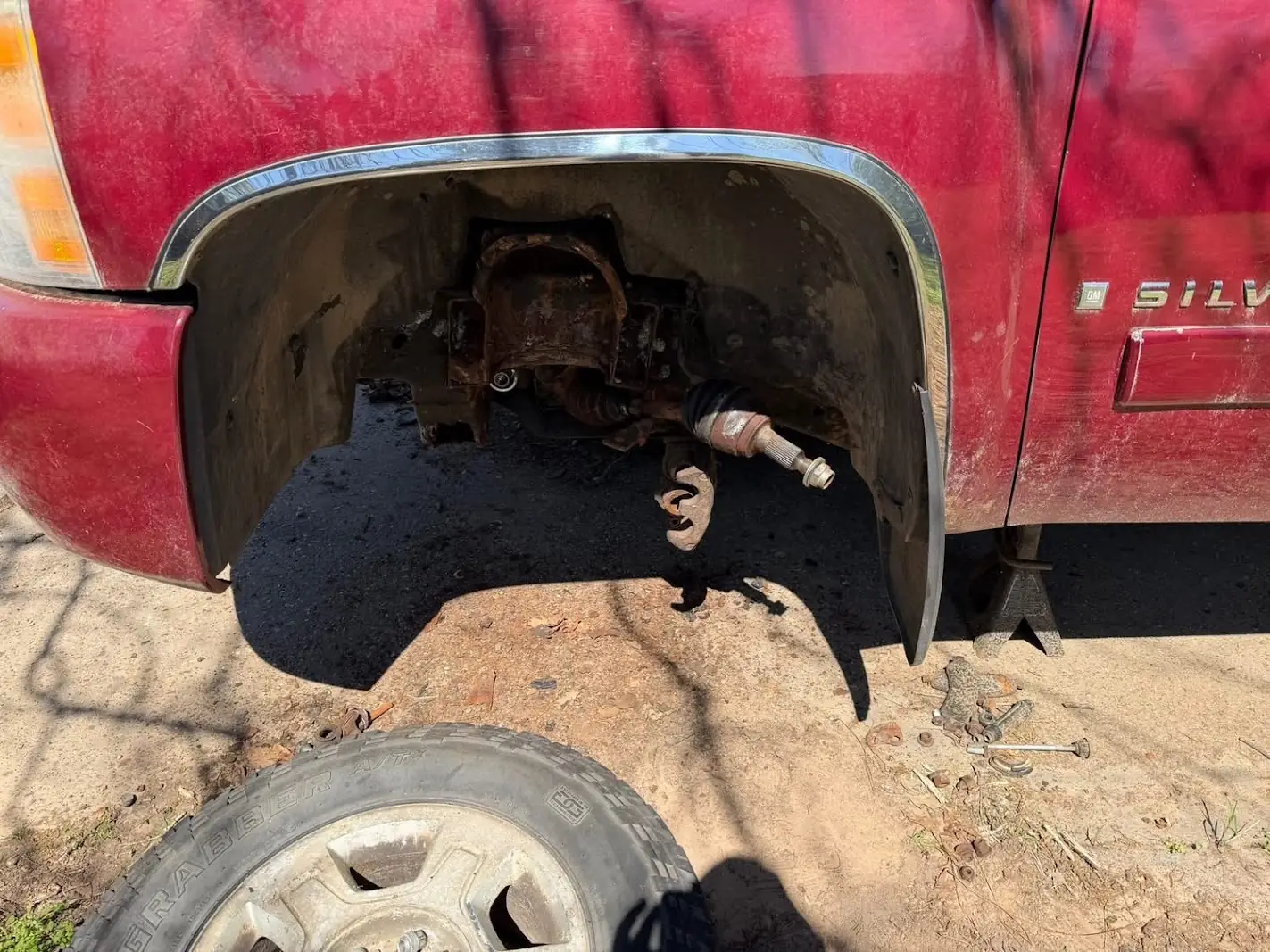
When I Check a Ball Joint, What I Measure
A real check uses the number the maker wrote down for that car, not a feel.
AA1Car says the right way is to look up the factory spec and measure play, both up and down and side to side, with a dial indicator. Know Your Parts, a suspension parts tech site, describes the setup. Support the arm so the joint is unloaded, mount the dial indicator on the control arm, and measure how far the knuckle moves.
That’s why the old .050 inch rule gets people in trouble. It can pass a joint that should have zero play, or fail one that’s still in spec.
Before I replace anything, I check the parts that make the same noises. That means the tie rod ends, sway bar links, bushings and the wheel bearings. On our suspension and steering repair page you can read how we go about it. We tell you what we find, which parts are worn and what the repair involves, before any work starts.
Hearing a clunk from one front corner? Call or text Loyd at (918) 215-1206. We come to you in Tulsa and check the front end where the car is parked.
Can You Keep Driving on a Bad Ball Joint?
For a little while, slowly, maybe. I wouldn’t bet a highway trip on it.
MOOG says that with severe wear, the stud can separate from the housing, and that you lose control of the car right then. RealTruck says the wheel can separate from the car in extreme cases, mostly at highway speed or in a hard turn.
The trouble is there’s no gauge that tells you how close you are. A clunk that started last month could be early wear. It could be a joint near the end. You can’t tell from the driver’s seat.
So if you hear the noise, keep it to short, slow trips around town. Stay off I-44 and the Broken Arrow Expressway until someone has checked it. And if the steering suddenly feels very loose, or the car pulls hard over a bump, park it and have it looked at where it sits.
Oklahoma won’t catch it for you. Our post on why Oklahoma has no car inspection covers the checks worth doing on your own instead.
What the Repair Involves and What It Costs
How big the job is depends on how the joint is mounted.
AA1Car lists three ways. Some joints bolt in. Some are pressed into the control arm and need a hydraulic press to get out and put back. Some are riveted, and the rivets have to be drilled or chiseled out. And on some cars the joint is part of the control arm, so the whole arm gets replaced. On joints locked into the knuckle with a pinch bolt, AA1Car says to use a new bolt.
After the new part is in, the wheel angles have changed. RepairPal recommends a four wheel alignment after a ball joint replacement.
For a sense of price, RepairPal’s estimates updated September 3, 2026 put a Chevrolet Silverado 1500 ball joint replacement at $348 to $553, with $285 to $418 of that as labor. A Toyota Highlander comes in at $373 to $523. Those are national averages before tax, not my quote. Yours depends on the car, how the joint is mounted and what else is worn.
If a pothole started the noise, our pothole damage checklist covers the tire, wheel and alignment checks to do alongside it.
Mailbag
What does a ball joint sound like when it is bad?
Usually a dull clunk or knock from one front corner over bumps, dips and driveway lips. MOOG says it starts faint and comes and goes, then gets louder and more often as the joint wears. A dry joint can also squeak or creak when you turn at low speed.
Is it safe to drive with a clunking noise?
Not for long, and not fast. A clunk can be a cheap sway bar link or a worn ball joint, and you can’t tell which from the seat. MOOG says a badly worn joint can separate and cause a sudden loss of control. Get it checked before highway driving.
How long do ball joints last?
MOOG says 70,000 miles or more, and AA1Car gives 70,000 to 150,000 miles. Rough roads, potholes and torn boots shorten that.
How expensive is it to replace ball joints?
RepairPal’s September 2026 estimates run $348 to $553 for a Silverado 1500 and $373 to $523 for a Highlander, before tax. Plan on an alignment after. A joint that comes only with a new control arm costs more.
Can I replace ball joints myself?
Some people do. A bolt in joint is a fair job with good jack stands and a torque wrench. A pressed in joint needs a press, and AA1Car says a riveted one has to be drilled or chiseled out. Either way, the car needs an alignment afterward.
Will a bad tie rod make a clunking noise?
It can. A worn tie rod end can clunk and make the steering feel loose, the same as a ball joint. Rocking the lifted wheel side to side points to the tie rod. Rocking it top to bottom points to the ball joint.
Also See
Suspension and steering repair in Tulsa
Why a car shakes at highway speed
How to check your car after a pothole
Schedule a visit
Want the front end checked without a trip to the shop? Call or text Loyd at (918) 215-1206. We come to you in Tulsa, Sapulpa, Kiefer, Sand Springs, Jenks, Kellyville, Glenpool and Lotsee.
Receipts
MOOG Parts, Symptoms of Bad Ball Joints
AA1Car, Ball Joints, Carley Automotive Technical Library
Know Your Parts, How to Measure Ball Joint Wear
RealTruck, Four Symptoms of a Bad Ball Joint, updated February 25, 2026
NHTSA, Consumer Complaints Flat File, November 2026 download
NHTSA, Complaints File Field Guide, updated April 30, 2026
RepairPal, Chevrolet Silverado 1500 Ball Joint Replacement Cost, updated September 3, 2026
RepairPal, Toyota Highlander Ball Joint Replacement Cost, updated September 3, 2026
TRIP, Oklahoma Transportation by the Numbers, Tulsa News Release, April 22, 2025
Wikipedia, Vehicle Inspection in the United States